Elaine Leeder, president of the board at Ner Shalom, a Reconstructionist synagogue in Cotati, California, calls herself “a memorial candle” for the family she lost in the Holocaust. Her own story, “The Daymare,” traces a fear that took root when she was 11 — decades before she would learn that her grandmother, aunt, and uncle had been shot and buried in a pit in their village of Kupiskis, Lithuania. She didn’t discover what happened to them until she was in her 60s. But the fear had arrived long before the facts did, which Leeder now understands as intergenerational trauma: the aftershock of an atrocity reaching her before anyone had even told her the story.
That sense of duty is now bound between the covers of a book.
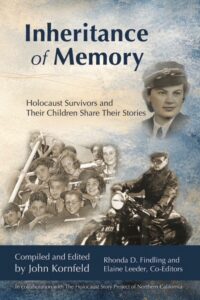 Leeder co-edited Inheritance of Memory, a new anthology aimed at junior high and high school readers, with John Kornfeld, a former associate provost at Sonoma State, and Rhonda Findling, a contributor and fellow Ner Shalom congregant. A third member, Peter Krohn, shared his own story for the collection. The project grew out of a speakers’ group of about 20 people who spent years visiting schools to share their parents’, and their own, Holocaust stories. “We’ve seen a lot of memoirs about the Holocaust, but each of us has a very different story,” Leeder says, “particularly because our families are from all over the world.”
Their families scattered across the globe before landing in the United States: some from Greece, some from Italy, some from Germany, some from Lithuania, some from Poland. A few took winding routes, starting in one country, passing through Shanghai or Palestine or South America, before finally settling in places like New Jersey. Fourteen of those family stories make up the book, organized in three parts: firsthand survivor accounts, stories from children of survivors, and a final section, the one Leeder’s own piece belongs to, about the long reach of intergenerational trauma.
Other stories in the collection carry similar weight. Findling’s father and five siblings survived by hiding, and the book includes a photograph of her uncle sailing into New York Harbor past the Statue of Liberty. Krohn’s story centers on a teddy bear, the one he carried at age five while fleeing Italy, torn apart by soldiers searching for contraband, and the pain of being separated from the non-Jewish au pair who had raised him.
“All the stories are tragic but uplifting,” Leeder says. “It’s not, ‘ain’t it awful.’ It’s look at how we survived, look at how we thrived, look at how we have overcome remarkable adversity.”
The book title captures what the book is trying to do. “We took our family stories, we inherited it, like you might inherit silver or pieces of family lore,” Leeder says. “And now we’re passing that memory on.”
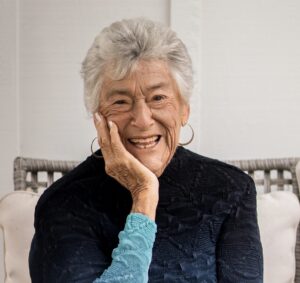 For Leeder, the project’s urgency lies in what it teaches teenagers about the present, not just the past. When she and fellow speakers visit schools, they draw a direct line between the history in the book and the dynamics students witness themselves. Prejudice, she tells them, doesn’t start with genocide. “It starts with simple things like othering people, name-calling, bullying,” she says. She points out that the same pattern, scapegoating and marginalizing a group, has touched other communities as well, from Latinos to African Americans to immigrants, and that recognizing it early is exactly the point of telling these stories to a young audience.
Leeder wrote her contribution years before she found her way to Ner Shalom. She was raised Orthodox, and for much of her adult life she moved away from organized Jewish practice altogether, describing herself as “a rebel, atheist, anarchist, lesbian, feminist.” Reconstructionism, and Ner Shalom in particular, changed that. “This place brought me back to my Judaism in a way that is contemporary, relevant and deep,” she says. “Before it was just rote. Now it’s meaningful and deep and always explained.” These days, she doesn’t describe herself as a believer so much as someone still searching. “I would say I’m a seeker,” she says, “and Reconstructing Judaism is helping me in my seeking.”
History, she says, has to be preserved, “because if you don’t learn from it, it repeats itself. And even if you do learn from it, it repeats itself.” It’s a fight she knows may never be finished. “I feel sometimes like I’m whistling in the wind,” she says, “but I’m going to keep whistling.”