
By Erica Levi Zelinger
The well-worn mantle covering a beloved Torah at Congregation Dorshei Emet in Montreal had been repaired more than once. But even well-loved fabric can only be mended so many times. What began as a practical need for a new one became a years-long communal undertaking, with members stitching together their talents to create a fittingly personal mantle for Torat Imeinu, a Torah scribed especially for their congregation.
“The idea of everybody pitching in and doing what they’re good at doing is very much part of our history,” says Audrey Berner, president of Dorshei Emet. “When something needs to be done, you just do it.”
Doing it, however, would take a while.
The project began before COVID, when Rami Negev approached Berner about the deteriorating mantle. They brought textile artist Leslie Dolin into the project, bought fabric and trim and gathered around Berner’s kitchen table to begin planning. Then the world shut down, and the materials went into a box on top of Berner’s bookshelf, where they remained for years.
Once work resumed, members contributed their talents in appliqué, embroidery and sewing. Rabbi Boris Dolin took on the woodworking, creating a new wooden form rather than reusing the old one.
Berner describes the process as “fun and frustrating.” People got busy, went out of town and worked around other commitments. At one point, they discovered that fabric purchased years earlier was six inches too short.
But the finished mantle was never intended simply to be beautiful. The group wanted it to “reflect who we are as a congregation,” Berner says.
That story is embedded in its design.
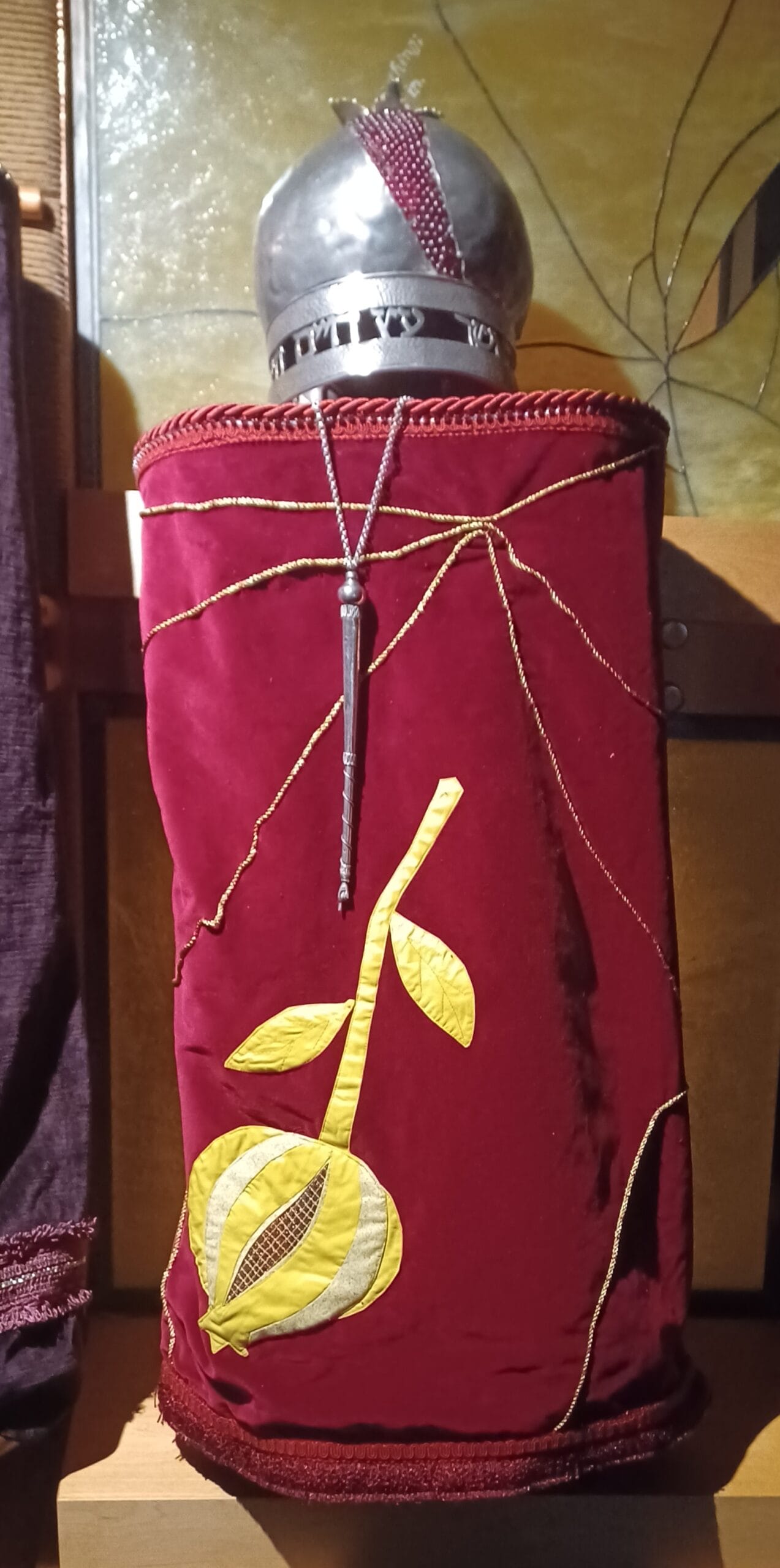 The appliquéd pomegranate echoes an image found throughout Dorshei Emet, including on its siddur, machzor and Yizkor book. The Torah’s keter, or crown, is itself a pomegranate. “It just made sense,” Berner says. “We had to include the pomegranate.”
The lines running across the mantle carry a more poignant history. After Dorshei Emet’s rabbi of 40 years, Rabbi Ron Aigen, z”l, died suddenly, a colleague spoke at his funeral about kintsugi, the Japanese practice of visibly repairing broken objects. Months later, during a memorial service originally planned as Aigen’s retirement celebration, the already-cracked glass behind the Torah shattered as the Torah was returned to the ark.
The congregation gathered the pieces and created a kintsugi-inspired window, repairing the glass with copper lines and leaving one piece clear where a ray of light had entered the sanctuary when it shattered. They also etched the window with words from Montreal-born Leonard Cohen’s “Anthem”:
“There is a crack in everything. That’s how the light gets in.”
When the mantle was designed, those cracks became part of it, too.
“That window became way bigger than I think we ever intended it to become,” Berner says. “So the Torah with the cracked lines in it just made sense.”
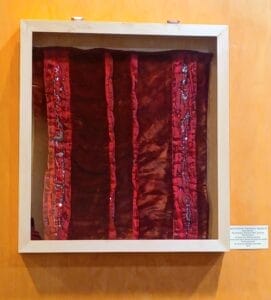 And creating something new did not mean leaving the past behind. The new mantle carries pieces of Dorshei Emet’s history in its pomegranate and kintsugi-inspired lines, while the mantle that came before it has found a new place in the synagogue. At the request of the original mantle’s designer, another member built a shadow box, Berner repaired some of its beadwork, and today it hangs near the synagogue entrance.
“We care about what other people have done,” Berner says. “We don’t want to throw things out just because they’re old.”