
By Erica Levi Zelinger
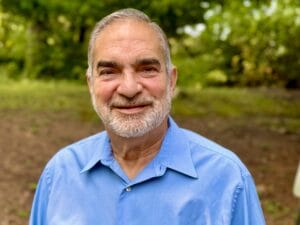 When Rabbi Jacob Staub became RRC’s academic dean and vice president for academic affairs in 1989, he was thinking about something he had found missing from his own rabbinical education.
His training had been rigorous and deeply academic, focused on Jewish history, texts and their meaning in context. But when it came to what he now calls “spiritual formation and spiritual growth,” students were largely on their own.
For Staub, rabbinical education needed to shape more than what students knew. It needed to tend to the people they were becoming.
Over the next several years, RRC experimented with different ways to bring spirituality more fully into the life of the college. Then, in 1997, faculty member Nancy Fuchs Kreimer told Staub about a master’s program in spiritual direction at nearby Chestnut Hill College. RRC brought in leaders from the program for a daylong consultation.
“We were introduced to this practice of what they called ‘spiritual direction,’” Staub recalled. “And it worked.”
RRC launched its Spiritual Direction Program in 1998 with Barbara “Bobbi” Breitman, who trained as a spiritual director at the Shalem Institute and taught pastoral counseling at RRC. At a time when, as Staub remembers it, the prevailing attitude in much of the Jewish world was that “Jews don’t do spiritual,” the program represented something new in rabbinical education.
Among the students in that first cohort was Rabbi Elliott Tepperman, now RRC’s CEO and president. For Tepperman, spiritual direction offered a way to cultivate the inner life that would become essential to his work as a rabbi.
“One part of the job of being a rabbi is to be inspirational,” Tepperman says. “I learned early on that I couldn’t be inspirational if I was not myself inspired. It was in spiritual direction that I honed my ability to look inward to name my own spiritual truth.”
A guide, witness and companion
Despite its name, spiritual direction is not about telling someone what to do.
“The director is not really a director,” Staub says. “The director is a guide or a witness or companion.”
Unlike therapy or pastoral counseling, the goal isn’t primarily to solve a problem. A student might bring a difficult relationship, questions about prayer or God, uncertainty about their future or a challenge they are facing in rabbinical school. The spiritual director listens and helps the student discern what may be happening beneath the surface.
“We witness and try to help them discern where God is, where the Holy is in what they’re going through,” Staub says.
That language is intentionally expansive. From the beginning, Staub wanted the program to work for students with widely differing beliefs and spiritual practices.
“You didn’t need to believe in God or in any particular kind of God,” he says. “This was for everyone. You can start wherever you want.”
For some students, the work might involve prayer or Jewish texts. Staub described working with a student who wanted to become more comfortable with the siddur and learn to lead prayer “from the inside out.” Together, they focused on individual lines from prayers and psalms, exploring what those words might mean in the student’s own life.
For others, spiritual direction might begin with a much broader question: Where is the holy, the divine or the mysterious in what I am experiencing right now?
“It’s a practice,” Staub said, “of learning to see the divine, the Holy, the mystery, in every moment.”
An education that tends the whole person
RRC Students are invited to participate in spiritual direction but never required to do so, a distinction Staub has defended strongly over the years. He estimates that at least 70 percent of students have voluntarily participated in a given year, and that roughly 90 percent have taken part for at least a year or two by the time they graduate.
Students select from a group of spiritual directors and can meet with their director up to eight times during the academic year. Some stay with the same person throughout rabbinical school; others change directors to experience different approaches. Some graduates continue meeting with their directors long after leaving RRC.
Tepperman remembers one of those conversations, when he was preparing to become a father and a rabbi and to leave RRC and Philadelphia, all at once. He brought his anxiety about those transitions to his spiritual director, Dr. Simcha Raphael.
“Simcha invited me to reimagine the moment I was experiencing as the deep history of my future child,” Tepperman recalls. “This reframing of my own life as part of a much bigger narrative helped me move from the narrowness of my own immediate concerns into a much more expansive spiritual landscape.”
Staub sees the practice addressing two needs he identified when the program began. One was helping rabbis sustain themselves while spending their careers serving others. The second was preparing them to sit with people confronting spiritual questions without feeling that those questions belonged to someone else.
His hope was that a Reconstructionist rabbi could sit with someone wrestling with God, faith or meaning and feel equipped to remain present in that conversation.
Bringing the practice into the rabbinate
The value of spiritual direction, Staub says, extends well beyond explicit spiritual moments.
A rabbi might draw on the practice while counseling someone through an existential crisis. But they might also draw on it during a contentious board meeting, amid professional uncertainty or when they simply feel overwhelmed.
“You have a developed practice of saying, ‘God help me. I need help. I need support,’” Staub says.
Just as important is the self-compassion that can come with acknowledging that a difficult situation really is difficult, that the rabbi doesn’t have every answer and can’t control every outcome.
Staub knows the power of that practice personally. He has met monthly with his own spiritual director, the Rev. Susan Cole, for approximately 28 years. During an especially painful period in his life, Cole urged him to ask for help. Staub initially resisted because the idea didn’t fit his own theology of God.
Eventually, he found words he could use: “I need help.”
The experience didn’t change his circumstances. It changed his relationship to them.
“I understood that I was not in this alone,” he says. “And I was in touch with my own capacities and I was in touch with all the people I had who supported me. And the world looked different when I wasn’t trying to do it alone.”
For Staub, that’s especially important because rabbinic work can be isolating. Rabbis are called upon to lead, teach, counsel and support communities, often while carrying their own questions and struggles.
Spiritual direction creates a place where, for an hour, the rabbi or rabbinical student is the one being tended.
Staub describes what a spiritual director offers in simple terms: “What I give is total attention. I’m not thinking about me. I’m not thinking about anything else. I’m listening to every word of what you’re saying.”
For Tepperman, that attention to a rabbi’s own inner life has remained important long after rabbinical school.
“Over the years I have returned to spiritual direction particularly when my heart was heavy or my spiritual life was feeling vacant,” he says. “My experience in spiritual direction at RRC created a doorway into my own soul. Reminding rabbis to stay attuned to their soul has not always been core to rabbinic training. It is, however, essential.”
Nearly three decades after RRC began experimenting with a practice then unfamiliar in Jewish institutional life, spiritual direction has spread to other rabbinical schools and Jewish settings. But at RRC, its purpose remains rooted in the question that inspired the program in the first place: What does it mean to educate not only a student’s intellect, but the whole person who will become a rabbi?
For Staub, part of the answer is helping future rabbis learn that they don’t have to do the work alone.