
By Erica Levi Zelinger
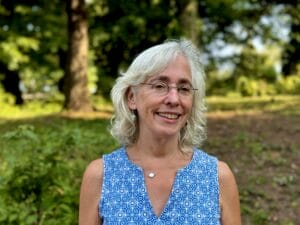 When a student asks why God told Abraham to sacrifice his son, Professor of Bible Elsie Stern has a ready answer: “God didn’t.” The better question, she says, is why our ancestors told this story about Abraham in the first place.
That shift is the heart of Biblical Civilization, which every RRC rabbinical student takes in their first semester. The course introduces the civilizational method through two big ideas. One: Torah is an anthology, with many sources and perspectives, and its texts respond to the times in which they were written. And two: Reconstructionists say there is never one Judaism, only Judaisms. The same, Stern notes, is true of Torah.
The approach also eases a common worry. Students who love Torah deeply can feel anxious when it clashes with their ethics. “It would be weird if you shared all the values of 7th-century Judeans,” Stern says, and the texts didn’t always agree with each other either.
Annie Prusky, a fourth-year student serving this term as the course’s teaching assistant, sees that tension firsthand. “First-year students often come excited to read, study and use Jewish text, but sometimes the civilizational lens is hard to hold while also treating these texts as sacred,” she says. Learning to switch between lenses is one of the main undercurrents of the revamped course. Stern, Prusky adds, sometimes calls it moving between “security camera truth” and “spiritual truth.”
In class, students watch lectures and read podcasts and articles beforehand. Stern’s rule is that anything she’d talk about for more than 10 minutes becomes a video, leaving class time for discussion, often prompted by “MacMillan,” an imaginary learner who voices the questions contemporary Jews bring to the text.
Now teaching the course for the 19th time, Stern decided it was time to “kill some sacred cows.” She went through the syllabus and cut what no longer served her students, then realized the whole opening section was a sacred cow too. She revised three of the five opening classes, replacing much of the earlier focus on how the texts were composed and used in the ancient world with new units on empire and migration. Much of Torah took shape under powerful empires and in the wake of forced exile and return, she explains, and those experiences left their mark on the text. “Once you start looking for empire and migration, they’re everywhere,” she says. (Isaac is the only major Torah character who never migrates!)
In the first class to experience the new opening, one student exclaimed: “Really? Nobody else got this at the beginning? It feels so important!”
The new units go beyond memorizing facts. “It’s more than just learning dates and names,” Prusky says. “Students get to know the geography of the lands in which our tradition grew and the cultural and political norms which shaped the lives of the authors of our sacred texts.”
The course also asks students to take the ideas out of the classroom. In a favorite assignment on the Exodus, they interview three Jews, only one of whom may be a rabbinical student, about what the story means in their lives. “Somebody always interviews their mother,” Stern laughs.
The goal is to shape rabbis who broker texts thoughtfully, whether in a pulpit, classroom or hospital room. Reading Torah this way, Stern says, turns its frictions into a way to make meaning. That includes learning to hear many voices in the text. According to Prusky, students “learn to identify and honor multivocality in the text, which helps them feel more empowered to develop their own interpretations.” The class, she adds, “helps establish the foundation rabbinical students will use for the rest of their time at school and, hopefully, for their rabbinic careers in the future.”