
By Erica Levi Zelinger
When Nancy Katz enrolled in the inaugural cohort of RRC’s Binyan Certificate Program, she wasn’t contemplating rabbinical school or looking for another credential. After a career in public service as a lawyer and judge, she wanted to do something that challenged her.
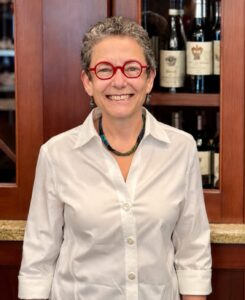
“One of my goals in retirement was to do something that I hadn’t done before and that wasn’t easy for me,” Katz says.
She found that challenge in Binyan.
Katz had been slowly working on Biblical Hebrew when she learned about the new certificate program. The opportunity to study with RRC faculty, offered Katz a chance to move beyond the more informal Hebrew study she had pursued on her own.
“I like the structure of the program,” she says. “There’s an impetus to stay with it and to study and to delve deeply.”
Her goal is ambitious: to eventually read Torah fluently in Hebrew without relying heavily on English translation. Binyan’s intensive Hebrew course is helping her get there.
But some of Katz’s most meaningful learning has come from a course she initially viewed almost as an add-on: Reconstructionism.
Studying Mordecai Kaplan’s intellectual development and Reconstructionist approaches to theology has given Katz new ways to understand both her own Judaism and her congregation. As president of the board of directors of Jewish Reconstructionist Congregation (JRC) in Evanston, Ill., she finds herself applying what she learns in class to questions of congregational life and leadership.
She is already planning to use Kaplan’s ideas as the framework for her annual congregational report, assessing how JRC measures up to his vision for modern Jewish life. Her prediction? “I think we’re gonna get an A+.”
“One of the gifts of having Nancy in the class is that she can speak to years of experience being part of a Reconstructionist community,” says Rabbi Alex Weissman, who teaches the course on Reconstructionism. “We can read about different Reconstructionist approaches to prayer and theology, but Nancy can point to specific practices and norms in her community and say, ‘This is how we live this in practice.’”
Binyan has also put Katz in conversation with learners at very different stages of their lives. Her cohort includes people considering rabbinical school, while her Reconstructionism class brings Binyan participants together with current RRC students.
Among her classmates is rabbinical student Marques Hollie, RRC ’28, who also serves as JRC’s rabbinic intern.
“It just so epitomizes Reconstructionism,” Katz says. “We’re all teachers and we’re all learners. We’re kind of building community.”
For Katz, that connection between learning and community feels like a continuation of the work that has shaped her life. She describes tikkun olam as a thread running through her work in public interest law, her years on the bench and now her leadership at JRC.
Binyan is giving her new tools for that work while also providing something simpler: the joy of being a student again.
“I’m just enjoying the learning,” Katz says, “and I’m just enjoying the structure of it and the requirement to really dive deeply and to think and write.”
And she is already thinking about what comes next: bringing what she has learned home by leading a Reconstructionism reading group at JRC and encouraging other congregants to consider Binyan themselves.